MemoLazy
A spaced-repetition study app built on FSRS-6, where one deck can be studied four different ways and the rest of a degree — notes, deadlines, grades — sits on the same timeline as the reviews.
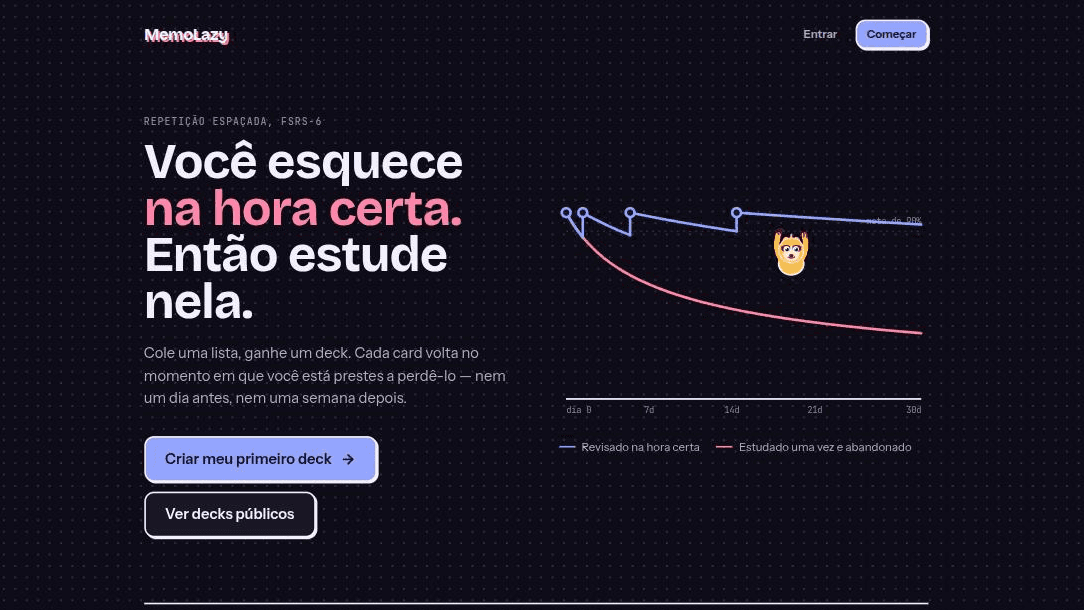
Flashcard apps schedule cards and stop there, so everything else a degree needs — notes, deadlines, grades, absences — lives in other tools. And a card studied once in a burst is a card forgotten a week later, which is exactly what the scheduling is supposed to prevent.
Live at anki-lazy.vercel.app with public decks to browse, and a companion React Native app that shares the same scheduling package as the web client rather than reimplementing it.
About this project
MemoLazy brings each card back at the moment you are about to forget it, using FSRS-6 — the algorithm that superseded the SM-2 scheme Anki made familiar. The scheduling, queue and grading logic lives in a shared workspace package with its own test suite, so the Next.js web client and the React Native app schedule identically instead of drifting apart. One deck can be studied four ways: flip-and-grade review, a learn mode that moves from multiple choice to writing the answer from memory, a generated exam, and a timed matching game — and all four feed the same scheduler, so time spent in the game is not time lost from review. Around the flashcards it carries the rest of the semester: each course groups its own decks, notes, deadlines, grades and absences; notes are written in markdown, where any line containing :: becomes a flashcard; and exams and deadlines sit on the same timeline as the day's reviews, alongside a running average of how much is still needed to pass and how many absences are left. An AI layer turns a pasted list into a deck, drafts notes and expands existing ones. Data lives in serverless Postgres through Drizzle ORM, with uploads on Vercel Blob.
Key Features
Tech Stack